
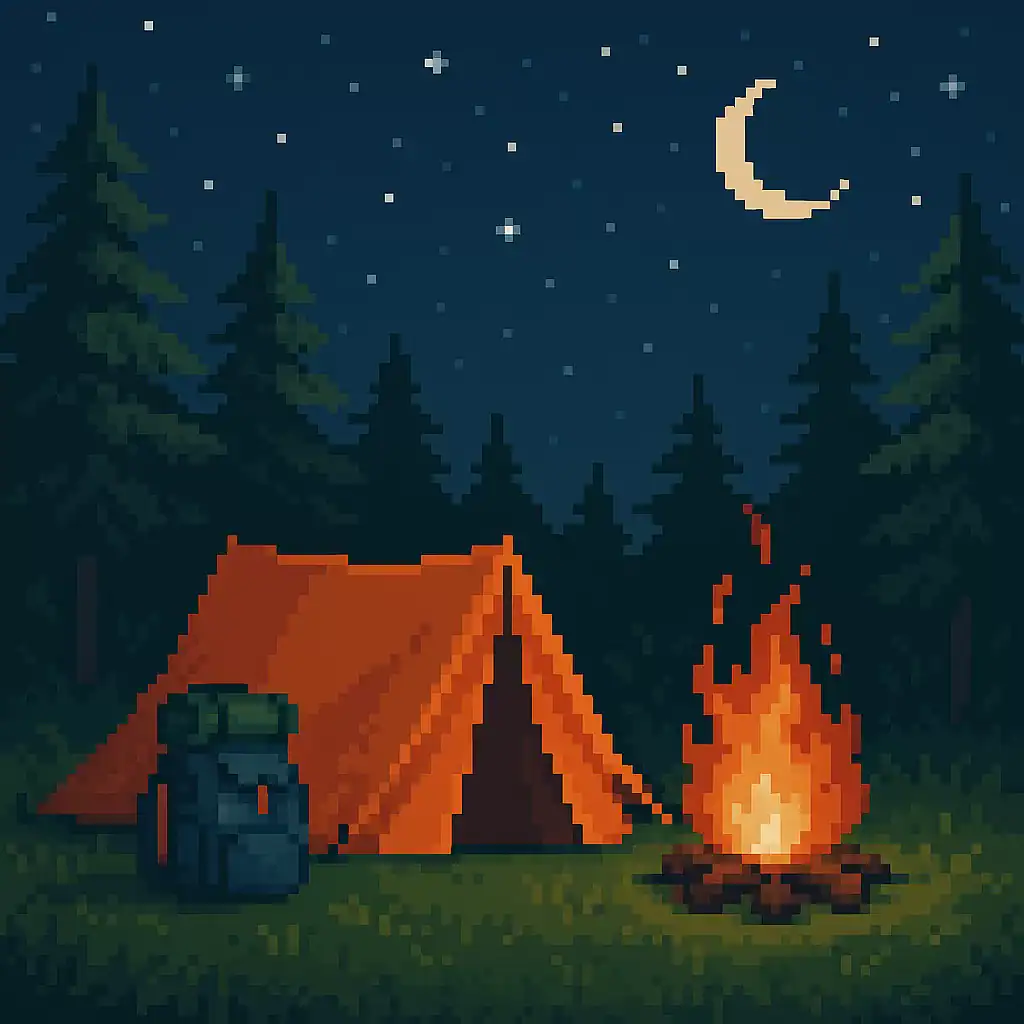
Hello, students! Welcome back to our Papagaio Portuguese blog. Today, we are going on a virtual trip to learn vocabulary and grammar for a camping trip (viagem de acampamento). This is a very popular activity in Brazil!
We will use a simple text about a trip to Chapada dos Veadeiros, a beautiful national park in Goiás, Brazil. Let’s learn how to talk about future plans in Portuguese!
Grammar Notes: Portuguese Camping Vocabulary and the Future with “IR”
In Portuguese, one of the easiest ways to talk about the future is to use the verb IR (to go) + another verb in the infinitive.
The basic structure is: Subject + conjugation of IR + verb (in the infinitive)
This is exactly like saying “I am going to eat” or “She is going to travel” in English.
Let’s look at this structure with different people, using our camping theme:
· Eu vou para a Chapada dos Veadeiros amanhã. (I am going to Chapada dos Veadeiros tomorrow.)
· Você vai acordar cedo? (Are you going to wake up early?)
· Ele vai armar a barraca perto do rio.(He is going to set up the tent near the river.)
· Nós vamos fazer uma fogueira grande.(We are going to make a big campfire.)
· Vocês vão nadar no rio de tarde?(Are you [all] going to swim in the river in the afternoon?)
· Eles vão voltar para o acampamento no domingo. (They are going to return to the campsite on Sunday.)
It’s very easy! Personal Pronoun + VAI/VÃO/VAMOS + verb = [Someone] is going to do [something].
Drag and drop to match the correct answer!
Let’s Expand: “What are you going to bring to the campsite?”
Now, let’s see how to use this structure with all the personal pronouns.
A very useful question for our camping theme is:
“O que você vai levar para o acampamento?” What are you going to bring to the campsite?
Here is the conjugation of the verb IR in the present tense + the verb levar (to bring):
· Eu vou levar uma lanterna e um saco de dormir. I am going to bring a flashlight and a sleeping bag.)
· Você vai levar o repelente? /(Are you going to bring the insect repellent?)
· Ele / Ela vai levar uma mochila grande. (He / She is going to bring a big backpack.)
· Nós vamos levar sanduíches e suco. (We are going to bring sandwiches and juice.)
· Vocês vão levar as barracas? (Are you [all] going to bring the tents?)
· Eles / Elas vão levar a bola de futebol. (They are going to bring the soccer ball.)
See? The structure is always the same: [Personal Pronoun] + [conjugation of IR] + [verb in the infinitive].
Now you can talk about anyone’s future plans!
Drag and drop to match the correct answer!
Time Adverbs (Advérbios de Tempo)
Adverbs of time tell us when something happens. They are very important for telling stories! You saw many in our text:
· De manhã: In the morning
· Até: Until / To (as in “drive to the campsite”)
· Depois: After / Afterwards
· À tarde: In the afternoon
· De noite: At night
· No dia seguinte: The next day / The following day
Read the text below. It describes a plan for a camping weekend:
Our Camping Story: Um dia de acampamento
Hoje é dia 20 de setembro, um sábado de sol, um lindo dia para acampar com os amigos.
Nós vamos para a Chapada dos Veadeiros, Goiás, Brasil.
De manhã vamos acordar cedo e dirigir até o nosso acampamento.
Lá, vamos armar as barracas e montar as mesas.
Depois, vamos caminhar perto do rio e nadar.
À tarde vamos tomar banho e depois cozinhar.
De noite, vamos fazer uma fogueira, tocar violão, ver as estrelas e dormir.
No dia seguinte vamos fazer uma trilha e vamos comer sanduíches de atum e suco de laranja.
De tarde, vamos voltar para o acampamento, arrumar nossas coisas e ir embora.
Practice your Portuguese camping vocabulary by identifying objects and matching their names to the right spots in the picture.
This one is a little harder!
Drag and drop each phrase to match it with its correct meaning or translation.
That’s a wrap!
We hope you enjoyed this camping adventure while learning new Portuguese words and practicing how to talk about your future plans.
Remember, language is about living experiences, not just memorizing words.
So, pack your mochila, keep your curiosity alive, and join us for the next trip!