

Mastering Portuguese Time Adverbs: Today, Tomorrow, and Beyond!
Hello, language learners! One of the keys to sounding natural in any language is getting a handle on time adverbs, those little words that tell us when something happens. In Portuguese, some of these words look familiar to English speakers but can be used in slightly different ways.
Let's break down some of the most essential Portuguese time adverbs, from the times of day to talking about yesterday, today, and tomorrow.
1. The Times of the Day
These adverbs describe which part of the day something happens.
· De manhã (in the morning)
· Example: Eu estudo de manhã. (I study in the morning.)
· De tarde (in the afternoon)
· Example: Nós trabalhamos de tarde. (We work in the afternoon.)
· De noite (in the evening / at night)
· Example: Eles saem de noite. (They go out at night.)
🔍 Important Note: In Portuguese, we use the preposition "de" (of) to form these phrases. You literally say "of the morning," "of the afternoon," etc.
2. Today, Yesterday, and Tomorrow
This trio is your best friend for talking about daily life.
· Ontem (yesterday)
· Example: Ontem foi quente. (Yesterday was hot.)
· Hoje (today)
· Example: Hoje é sexta-feira! (Today is Friday!)
· Amanhã (tomorrow)
· Example: Choverá amanhã. (It will rain tomorrow.)
3. Early vs. Late: A Crucial Pair
These two words are opposites and are used just like in English.
· Cedo (early)
· Example: Eu cheguei cedo em casa. (I arrived home early.)
· Tarde (late)
· Example: Não chegue tarde! (Don't arrive late!)
⚠️ Watch Out! The word "tarde" has two meanings:
- As an adverb meaning "late" (Cheguei tarde - I arrived late).
- As a noun meaning "afternoon" (Boa tarde! - Good afternoon!).
4. The Word "Dia": A Versatile Workhorse
The word "dia" (day) is used in many common expressions.
· O dia todo (all day)
· Example: Ele trabalhou o dia todo. (He worked all day.)
· Todo dia (every day)
· Example: Eu corro todo dia. (I run every day.)
· De dia (during the day / in the daytime)
· Example: É mais seguro caminhar de dia. (It's safer to walk during the day.)
Putting It All Together: Sample Sentence
Let's see how these words work in real-life contexts.
- Ontem de noite, eu assisti um filme.
(Last night, I watched a movie.)
- Hoje de manhã, eu acordei cedo.
(This morning, I woke up early.)
- Amanhã de tarde, nós temos uma reunião.
(Tomorrow afternoon, we have a meeting.)
- Ela trabalha o dia todo e estuda de noite.
(She works all day and studies at night.)
- Todo dia, eu leio de manhã.
(Every day, I read in the morning.)
Quick-Cheat Summary
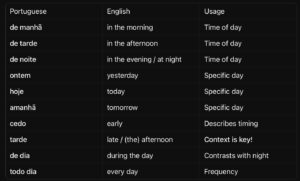
Keep practicing these adverbs, and you'll be talking about your daily routine in Portuguese with confidence in no time!
Try to match the adverbs in this interactive activity
Try to match the adverbs in this interactive activity
Test your knowledge in this Quiz
Sort out the correct answers
Enjoyed this lesson and learned something new? Dive deeper into the Brazilian Portuguese language with Papagaio!
We create clear, practical, and engaging lessons to help you move from confused to confident. Follow us for your daily dose of Portuguese tips, quizzes, and cultural insights.