
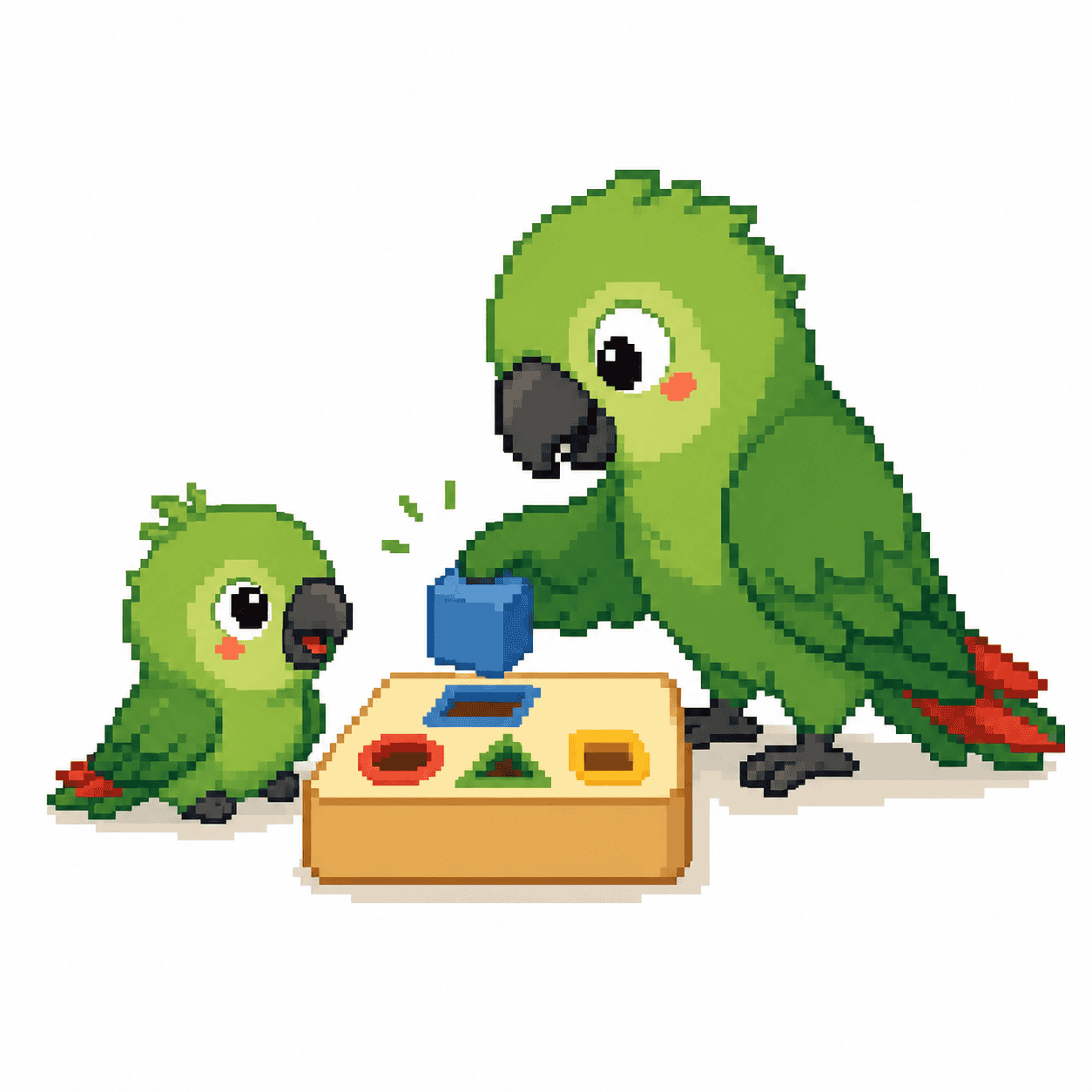
An educational game is a game designed to help people learn something while they play. Instead of separating study from fun, educational games combine goals, challenges, feedback, and interaction to make learning feel more active.
In language learning, this idea is especially powerful. A good educational game does not only ask learners to memorize words. It gives them a reason to use those words inside a situation.
For example, instead of simply studying the word pão, a learner might need to help a character buy breakfast in Portuguese. The word becomes part of an action, a decision, and a context.
Guide
- What is an educational game?
- How educational games work
- Why games help people learn
- Educational games and language learning
- Gamification vs educational games
- Papagaio and educational games
- FAQ
What is an educational game?
An educational game is a game created with a learning purpose. The player is not only trying to win, collect points, or finish a level. The player is also practicing a skill, understanding a concept, or developing knowledge through the game experience.
This can happen in many ways. Some educational games teach math, science, history, coding, geography, or languages. Others focus on problem solving, memory, creativity, collaboration, or decision-making.
According to Wikipedia’s overview of educational games, educational games are designed with educational purposes or have educational value. In simple terms, they help people learn while playing.
The most important part is that the learning goal is connected to the game design. A strong educational game does not feel like a worksheet with colorful rewards. It feels like a real activity where learning helps the player progress.
How educational games work
Educational games usually work by turning learning into a system of action and feedback.
The player receives a goal, tries something, gets feedback, adjusts, and tries again. This cycle is similar to how people naturally learn many real-life skills.
Good educational games often include:
- Clear goals: the learner knows what they are trying to do.
- Feedback: the game responds when the learner makes a choice.
- Challenge: the activity becomes harder as the learner improves.
- Progress: the learner can see development over time.
- Context: the skill is used inside a meaningful situation.
- Safe failure: mistakes are part of the process, not the end of it.
This is why educational games can be so different from traditional study methods. They allow learners to experiment instead of only consume information.
Why games help people learn
Games help learning because they make practice feel purposeful.
In traditional learning, students often ask: “Why am I studying this?” In a game, the reason is usually built into the experience. You need the skill to solve a problem, complete a quest, unlock a new area, answer a character, or make progress.
This makes the learning feel more connected to action.
In the academic paper Foundations of Game-Based Learning, Jan L. Plass, Bruce D. Homer, and Charles K. Kinzer explain that games as learning environments need to be understood through cognitive, motivational, affective, and sociocultural perspectives. That means games can support learning not only through information, but also through emotion, motivation, interaction, and context.
Games also make repetition easier. Repetition is important for learning, especially for language learning, but it can become boring when it feels mechanical. In a game, repetition can happen through challenges, levels, dialogues, puzzles, and different situations.
The learner is still practicing, but the practice feels less like memorization and more like interaction.
Educational games and language learning
Language learning is not only about memorizing vocabulary. To really learn a language, people need to understand meaning, context, tone, listening, reading, and communication.
This is where educational games can help.
A language learning game can place words and phrases inside situations. Instead of learning isolated vocabulary, the learner can use language to do something.
For example, a game can ask the learner to:
- talk to a character in Portuguese;
- choose the right phrase for a situation;
- read a clue to complete a quest;
- listen to a sentence and react correctly;
- use vocabulary to unlock a new interaction;
- review mistakes through a quiz after the dialogue.
This kind of design can make language learning feel more natural because the learner is not only studying the language. They are using it.
Gamification vs educational games
Gamification and educational games are related, but they are not the same thing.
Gamification means adding game elements to a non-game activity. This can include points, badges, streaks, leaderboards, levels, rewards, or progress bars.
An educational game goes further. The game itself becomes the learning environment.
This difference matters. A language app can have streaks and XP while still feeling like a normal lesson. That can help with motivation, but it does not automatically create a real game-based learning experience.
We explored this difference in more detail in our post about real gamification vs fake gamification. The main idea is simple: real educational game design connects progress to skill, not only to activity.
Papagaio and educational games
Papagaio is building an educational game experience for people learning Portuguese.
Our goal is not only to make language learning look more fun. Our goal is to make learning feel more interactive, contextual, and alive.
In Papagaio, Portuguese can be practiced through characters, choices, quests, challenges, and feedback. Instead of only seeing a word on a flashcard, learners can use that word inside a situation.
This matters because real communication is not just about knowing the correct translation. It is about understanding when, why, and how to use language.
Brazilian Portuguese is full of tone, culture, rhythm, expressions, and everyday situations. An educational game can help learners experience those details in a more playful way.
This is also connected to the broader foundation of Papagaio. In our post about the foundations of game-based learning, we explore how play, learning, and educational theory help shape the Papagaio approach.
Why educational games matter for the future of learning
Education is changing. People are used to interactive media, video games, social platforms, AI tools, and personalized digital experiences. Learning does not need to stay limited to passive reading, memorization, or traditional lessons.
Educational games offer another path.
They can make learning more active. They can help students practice through action. They can make mistakes feel less scary. They can connect progress to real understanding.
For language learning, this is especially important. A language is not only a school subject. It is something people use to communicate, travel, work, connect, and understand culture.
That is why educational games have so much potential. They can turn language learning into an experience instead of only a task.
Final thought
An educational game is not just a game with school content inside it. It is a learning experience designed around play, challenge, feedback, and progress.
When done well, educational games help learners practice skills in context. They make learning more active, more memorable, and more meaningful.
For Papagaio, this is the future of language learning: not only studying Portuguese, but using Portuguese inside a playful world built for learning.
Want to test Papagaio?
Papagaio is building an educational game for people who want to learn Portuguese in a more playful and interactive way.
Join the early access list if you want to test the game when it becomes available.
FAQ
What is an educational game?
An educational game is a game designed to help people learn something while they play. It uses goals, challenges, feedback, and interaction to support learning.
Are educational games only for children?
No. Educational games can be designed for children, teenagers, or adults. The important part is that the game teaches or reinforces a skill through play.
How can games help with language learning?
Games can help language learners practice vocabulary, reading, listening, decision-making, and communication inside meaningful situations.
What is the difference between gamification and an educational game?
Gamification adds game elements to a non-game activity. An educational game uses the game experience itself as the learning environment.
Can an educational game teach Portuguese?
Yes. A Portuguese educational game can help learners practice words, phrases, listening, reading, and cultural context through interactive situations.
How is Papagaio using educational games?
Papagaio is building a game-based language learning experience where learners can practice Portuguese through quests, characters, choices, and feedback.