
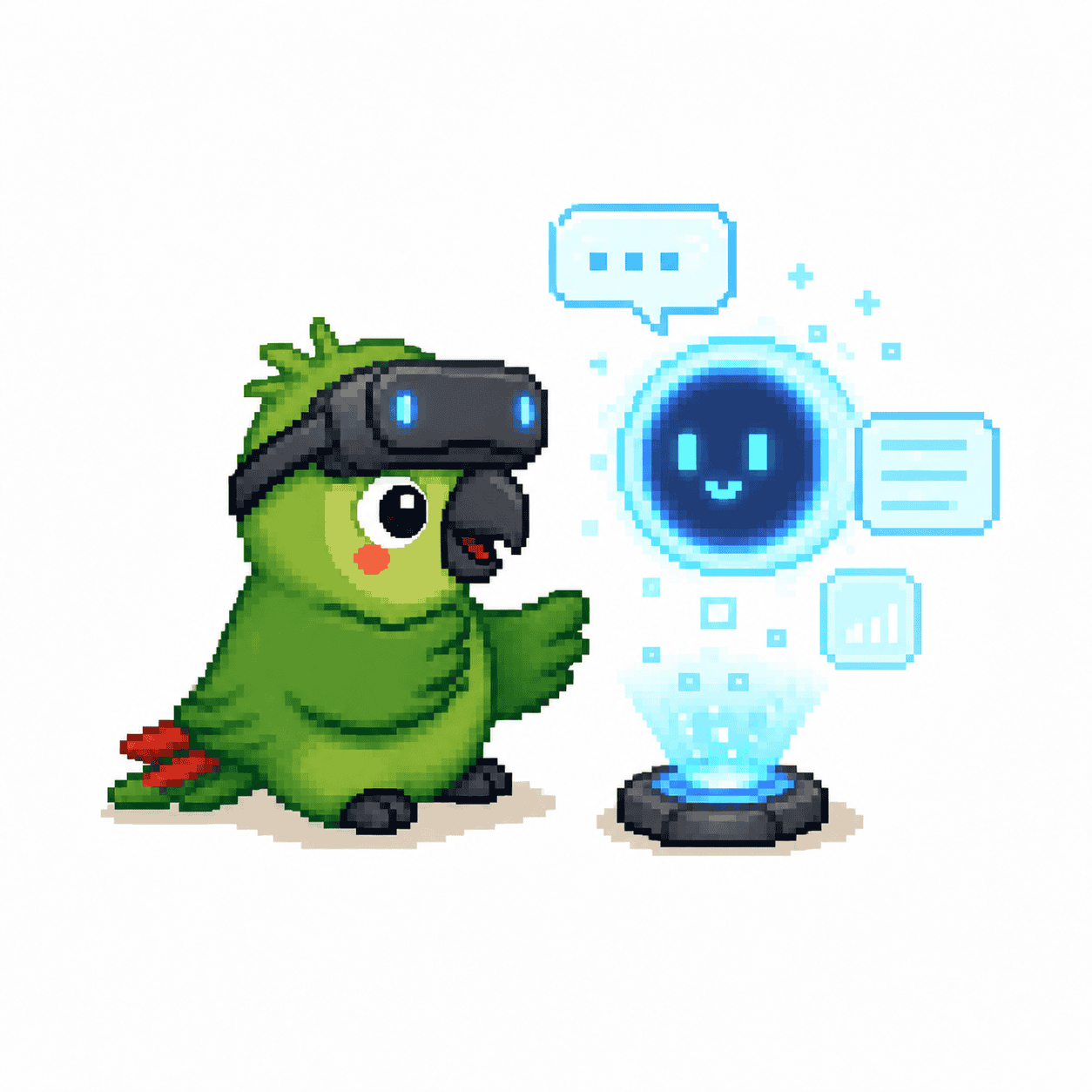
AI language learning is changing how people study, practice, and interact with new languages. Instead of relying only on textbooks, flashcards, or fixed lessons, learners can now use AI tools to receive feedback, practice conversations, generate examples, and study in a more personalized way.
This does not mean AI replaces teachers, culture, or real human communication. Language learning is still deeply human. But AI can become a powerful support system, especially when it helps learners practice more often, make mistakes safely, and receive guidance that fits their level.
For Papagaio, this matters because the future of language education is not only about putting lessons online. It is about creating interactive systems where learners can use language in context, receive feedback, and stay engaged through play.
In our previous post, we explained what game-based language learning is. Now, we are adding another layer: how artificial intelligence can support that experience.
Guide
- What AI means for language learning
- Personalized feedback for learners
- Conversation practice without fear
- Adaptive lessons and smarter review
- How teachers can use AI
- Papagaio and the future of interactive Portuguese
- FAQ
What AI means for language learning
AI in language learning means using artificial intelligence to support how people study and practice a language. This can include chatbots, pronunciation tools, writing correction, personalized exercises, adaptive quizzes, translation support, and feedback systems.
The biggest change is that learning can become more responsive. A traditional lesson is usually the same for every student. An AI-supported system can react to what the learner writes, says, misunderstands, or repeats.
For example, if a learner keeps confusing ser and estar in Portuguese, an AI tool could identify the pattern and create more practice around that specific problem.
This makes learning feel less generic. Instead of following only a fixed path, the learner can receive support based on their actual needs.
A broader overview of this topic can be found in Wikipedia’s article on artificial intelligence in education, which explains how AI can be used in learning environments through tutoring systems, feedback, and adaptive learning.
Personalized feedback for learners
One of the strongest uses of AI in language education is feedback.
Many learners practice alone. They write a sentence, say a phrase, or answer a question, but they do not always know if the answer sounds natural. A dictionary can translate words, but it does not always explain tone, context, or why one phrase works better than another.
AI can help by giving more specific feedback.
For example, a learner might write:
Eu sou com fome.
An AI-supported system could explain that in Portuguese, people usually say:
Eu estou com fome.
Then it could explain that hunger is treated as a temporary state, which is why estar is used instead of ser.
This kind of feedback is useful because it does not only mark an answer as wrong. It helps the learner understand the reason behind the correction.
Conversation practice without fear
Many language learners understand more than they can say. They may know vocabulary, grammar, and phrases, but they still feel nervous when it is time to speak or respond.
AI can help create low-pressure practice environments.
A learner can practice short dialogues, answer questions, repeat phrases, or simulate everyday situations without feeling judged. This can be especially helpful for beginners who need repetition before feeling confident with real conversations.
For Portuguese learners, this could mean practicing situations like:
- ordering coffee in a bakery;
- introducing yourself to someone;
- asking where something is;
- answering a simple message;
- choosing the right greeting for the situation;
- understanding casual Brazilian expressions.
AI practice is not the same as real human conversation, but it can help learners prepare for it. It gives them a place to try, fail, correct, and try again.
Adaptive lessons and smarter review
Another important use of AI is adaptive learning. This means the learning system can adjust based on the learner’s progress.
In traditional study, every learner may receive the same exercises in the same order. But real learners are different. One person may struggle with listening. Another may struggle with sentence structure. Another may understand grammar but forget vocabulary quickly.
AI can help identify these patterns.
For example, if a learner often misses questions about food vocabulary, the system could bring back words like pão, queijo, água, and café in new situations.
This is especially useful when combined with games. A game-based system can review language through quests, dialogues, puzzles, and character interactions instead of only repeating the same flashcard format.
This connects directly to our guide on what an educational game is. A strong educational game uses feedback, challenge, and progress to make learning more active.
How teachers can use AI
AI is not only useful for students. It can also support teachers.
Teachers can use AI to generate examples, create practice activities, adapt explanations, organize review questions, and prepare different versions of the same exercise for different levels.
For language teachers, this can save time and make lessons more flexible.
For example, a teacher could use AI to create:
- beginner dialogues using common Portuguese phrases;
- short reading exercises with specific vocabulary;
- quiz questions based on a lesson topic;
- roleplay situations for conversation practice;
- simplified explanations of grammar points;
- extra examples for students who need more practice.
However, AI should be used carefully. It can make mistakes, misunderstand context, or generate examples that sound unnatural. That is why human review is still important, especially in education.
Organizations such as UNESCO have also discussed the importance of using generative AI responsibly in education. Their guidance on generative AI in education and research highlights the need for thoughtful, human-centered use of these tools.
Papagaio and the future of interactive Portuguese
Papagaio is exploring how AI can support a more interactive way to learn Portuguese.
The goal is not to use AI only as a chatbot or a translation tool. The goal is to connect AI with game-based learning, feedback, and meaningful practice.
Imagine a learner talking to a character in Portuguese. The system could understand the learner’s response, give feedback, adjust the next challenge, and review important vocabulary later inside a journal or quiz.
This kind of experience can make language learning feel more alive. The learner is not only clicking through lessons. They are interacting, making choices, receiving feedback, and using Portuguese inside a playful environment.
This also connects to our post about real gamification vs fake gamification. AI should not only be used to make apps more addictive. It should help create more meaningful learning progress.
It also connects to the foundations of game-based learning, where feedback, motivation, emotion, and context all play an important role in the learning experience.
For Papagaio, the future of Portuguese learning is not just AI and not just games. It is the combination of both: AI-supported feedback inside an educational game designed for language learning.
Why AI matters for language learners
AI matters because language learners need more than information. They need practice.
They need to test sentences, hear examples, repeat difficult words, make mistakes, and understand why something sounds right or wrong.
AI can help create more opportunities for that practice. It can support review, feedback, personalization, and confidence-building.
But the best use of AI in language learning should still respect the human side of language. Culture, emotion, humor, tone, and real conversation matter. AI should support those things, not erase them.
Final thought
AI is changing language learning by making practice more personalized, responsive, and accessible.
When used well, AI can help learners receive feedback, practice conversations, review mistakes, and study in ways that fit their needs.
For Papagaio, AI becomes even more powerful when it is connected to play. A learner should not only study Portuguese through AI. They should be able to use Portuguese inside a game world where feedback, context, and discovery make learning feel natural.
Want to test Papagaio?
Papagaio is building an AI-supported educational game for people who want to learn Portuguese in a more playful and interactive way.
Join the early access list if you want to test the game when it becomes available.
FAQ
What is AI language learning?
AI language learning is the use of artificial intelligence to help people study, practice, and improve a language through tools such as feedback, conversation practice, adaptive exercises, and personalized review.
How is AI changing language learning?
AI is changing language learning by making practice more personalized. It can help learners receive feedback, generate examples, practice dialogues, and review mistakes based on their needs.
Can AI replace language teachers?
No. AI can support teachers and learners, but it does not replace human communication, cultural understanding, or the guidance of a good teacher.
How can AI help people learn Portuguese?
AI can help Portuguese learners practice vocabulary, sentence structure, dialogue, listening, writing, and feedback. It can also adapt review based on repeated mistakes.
Is AI useful for beginners?
Yes. AI can be useful for beginners because it allows them to practice simple phrases, receive corrections, and build confidence before using the language in real conversations.
How does Papagaio use AI language learning?
Papagaio is exploring AI-supported feedback inside a game-based language learning experience, where learners can practice Portuguese through characters, choices, quests, and interactive situations.